
Significance and impact of data quality on everyday hospital life, as well as control and decision-making processes
Summary
Today, many hospitals and hospital investors are losing hundreds of thousands to millions because they do not have data managers, stewards and revenue optimisers, nor do they have appropriate systems to check the accuracy and completeness of the content of the data sent or to bring out completely unused potential. On the one hand, revenues are given away in the parameterisation of the systems across all processes and on the other hand, inhomogeneous data increases the risk of wrong decisions. The result is unnecessary restructuring, wasted dividends, poorer cooperation between medicine, nursing and administration.
Introduction
And every day there is more of it. We are talking about data. It is estimated that we have collected more data in the last 40 years than possibly in the last 5,000. This is evident not only in Google, Facebook or the secret services, but also in hospital management. Where yesterday we only evaluated the balance sheet and income statement, today we evaluate entire patient histories or use this data to build up cost accounting in the finance department. The increase in statistical data to be provided, where we are measured in overall competition and sales, is constantly growing.
Duplicate addresses, postcodes that do not match the location and inhomogeneous data streams alone mean that letters are not sent correctly and statistics on patient origins are incorrect and have to be cleaned up. The result is wasted resources in the form of staff time in patient admissions and billing. In other areas, such as energy efficiency and purchasing policy, wrong decisions sometimes lead to wasted millions. This is not only because no data is available or it is faulty, but also because metadata is missing, for example.
The term data quality in hospitals is often equated with the business intelligence system. However, this is only a partial truth. Although it is important that data is kept homogeneous so that it can be evaluated via a system, the path to this is often not addressed. But it is precisely here that indirect as well as direct revenues are hidden.
Definition of data quality
Data quality is composed of the word data and quality.
According to ISO/IEC 2382-1 for information technology, data is a reinterpretable representation of information in a formalised manner, suitable for communication, interpretation or processing.
The standard DIN EN ISO 9000:2015-11 defines quality as „the degree to which a set of inherent characteristics of an object meets requirements“. With quality, it is possible to read the degree of correspondence to existing requirements.
This means that data quality serves to prepare information for communication, interpretation or processing in a standardised way so that it provides the requirement of „correct content“ for the user and its recipient. The ongoing check for content errors in the system represents the degree of measurement per day.
What is „right content“?
The right content is strongly linked to quality criteria and requirements. There are a number of such criteria. A non-exhaustive list is given below:
| Actuality | Level of information | Significance |
| Generality | Clarity | Verifiability |
| Age | Constancy | Degree of compaction |
| Usability | Correctness | Availability |
| Level of detail | Performance | Completeness |
| Uniqueness | Predictive content | Truthfulness |
| Gültigkeit | Quantifizierbarkeit | Zeitbezug |
| Häufigkeit | Relevanz | Zuverlässigkeit |
As early as 2007, the DQIQ embedded some of these criteria in an overall system and divided them into classes.
On the one hand, according to system, content, use and presentation.
In everyday work, the subdivision into these areas is still useful today, especially for „newcomers to the data detective agency“, as this makes it possible to see at a glance which areas such as IT, controlling or the specialist department one needs to speak to when a problem is present in the respective group.

[1] Figure Information Quality Model DQIQ 2007 (in German)
What measures can be taken to achieve a high level of quality in the long term?
In order to permanently achieve a high level of quality, both initial and continuous measures and procedures should be taken. It is advisable to set the regularity to 24 hours and to automate it as much as possible, so that the risk of lack of continuity in case of staff changes and holiday replacements is as low as possible.
The procedure can be divided into the following areas:
- Data Profiling = Data Analysis
- Data cleaning = data cleansing
- Data monitoring = monitoring the data
- Process and procedure optimisation
- Use of IoT and suitable infrastructure (optional)
When the data in the database is incorrect
Often, hospitals have hand-crafted SQL queries on various topics such as the postcode and town, missing surnames, etc. These, however, only cover exactly one database.
However, these only cover exactly one database.
The approach per se is not bad, but there is no overview of what the data looks like in other systems. For example, has someone stored this data in the HIS (hospital information system) and is it only missing in the billing system?
What is needed is a system that includes the first three steps and offers interfaces for all systems. Ideally with a simple integrator tool. A system that can also be easily operated by trained staff and does not contain any complex programming of rules. Such systems already exist with and without IA (artificial intelligence) and are mainly used in the purchasing area of insurance companies, online trading and for checking the invoices of health insurance companies. In other regions such as the USA, Canada, Australia and Asia, such systems are already being used in full or in part in hospitals.
What are the effects of a poor quality level?
A direct or indirect reduction in revenue due to poor process flows, information flows and communication possibilities.
At the beginning there is the question of accessibility and workability.
First and foremost, the process flow is affected because, for example, corrections or alternative information procurement (telephone call instead of direct query in the system) cause a slowdown here. Weeks, months or even years pass before these are changed, because the effects are not directly in management, but at the lowest level of information flow aggregation, the „raw data“. This slowdown leads to indirect costs due to wasted time resources. Five minutes may not sound like much at first, but when you add up the process chain, you realise that inevitably others are affected as well,
The next point is freedom from errors.
If you always send the wrong data, this leads to a lack of credibility and decisions are not made on the basis of the data. Consequently, the process flow is also slowed down at this point as alternative information gathering is needed or worse, decisions are made on gut instinct.
This is supported by the question of use.
Can the data be used? Are they complete. Ask your controller this question sometime. The answer will be: if the data is in the system, yes.
After all, how can a controller know whether all the data is in the system and can be evaluated at the same time if he has no access to all the databases and process flows? A controller is only as good as its main database. It may find errors from other systems and have them cleaned up, but it has no control over whether important and relevant metadata is missing.
An example of this is the sending of laboratory services as a separate service, although these were provided on an outpatient basis and by an external laboratory.
In the hospital in question, I was able to have 4 of 12 million per year corrected in the long term through my S.ucin.o method. Retrospectively for 4 years and by means of a regular audit avoid future errors. This is because outpatient, external services are paid for in Switzerland by the party that provided them. In other words, the external laboratory. The controller had no chance here, because for him the data was correct. How is he supposed to recognise whether the service was really provided by his own or by another laboratory?
The last thing missing in this chain is the question of the addressee.
Are my reports, my views in the software structured in a comprehensible way?
Does the recipient know which data view is available to him? The structure of cockpits and reporting, as well as the visualisation of the process design, is a science in itself. A simple example is the date question. Are the services evaluated according to the date of discharge of all patients, according to the date of service or, for example, according to the period of time. All three options are correct, the question is, which one promotes the right decision?
Impact of unused data potential
A simple and practical example of wasted data potential and in this case wasted revenue is energy.
A 50-bed hospital in Switzerland (old people’s home or clinic) has costs of about 300 to 400,000 CHF per year here.
Very few hospitals have measuring stations at large facilities like the MRI or control their open-plan offices or operating theatres by means of heat sensors. Depending on the manufacturer, an MRI can save 8 – 10 single-family homes per hour. Incidentally, switching off for one hour has already been implemented in practice. What is important for medicine is that the MRI needs a maximum of 10 minutes to start up.
It is often too cold in open-plan offices because out of 10 possible seats, only 5 are occupied. If you regulate the temperature based on the maximum number of people and do not let the room temperature run at maximum cooling, you save staff resources indirectly through reduced sick leave and directly through reduced energy and heating costs for air conditioning.
Literature
[1] https://www.itwissen.info/Datenqualitaet-data-quality.html
Publication:
Tagungsband Hamek 2018, Herausgeber Jürgen Nippa
This article appeared as part of a keynote speech by our CEO Hannah Bock-Koltschin at Hamek 2018.
You may also be interested in…..
 https://estrimago.com/wp-content/uploads/2023/03/Ada-Lovelace-first-coder-1.png
1200
1200
ESTRIBOSS
https://estrimago.com/wp-content/uploads/2023/03/ESTRIMAGO_web_PNG.png
ESTRIBOSS2023-03-08 15:29:412023-03-08 15:33:16Happy Women’s day
https://estrimago.com/wp-content/uploads/2023/03/Ada-Lovelace-first-coder-1.png
1200
1200
ESTRIBOSS
https://estrimago.com/wp-content/uploads/2023/03/ESTRIMAGO_web_PNG.png
ESTRIBOSS2023-03-08 15:29:412023-03-08 15:33:16Happy Women’s day https://estrimago.com/wp-content/uploads/2023/03/Digital-Healthcare-Ecosystems_EN.png
1080
1080
ESTRIBOSS
https://estrimago.com/wp-content/uploads/2023/03/ESTRIMAGO_web_PNG.png
ESTRIBOSS2023-03-04 19:47:042023-03-04 19:58:03Digitalisation in the hospital – interactive processes for more patient time and less costs
https://estrimago.com/wp-content/uploads/2023/03/Digital-Healthcare-Ecosystems_EN.png
1080
1080
ESTRIBOSS
https://estrimago.com/wp-content/uploads/2023/03/ESTRIMAGO_web_PNG.png
ESTRIBOSS2023-03-04 19:47:042023-03-04 19:58:03Digitalisation in the hospital – interactive processes for more patient time and less costs https://estrimago.com/wp-content/uploads/2023/03/Innovationen-Healthcare-management-EN.png
1080
1080
ESTRIBOSS
https://estrimago.com/wp-content/uploads/2023/03/ESTRIMAGO_web_PNG.png
ESTRIBOSS2023-03-04 19:26:012023-03-04 19:31:23Innovations in care management: How modern hospitals save millions
https://estrimago.com/wp-content/uploads/2023/03/Innovationen-Healthcare-management-EN.png
1080
1080
ESTRIBOSS
https://estrimago.com/wp-content/uploads/2023/03/ESTRIMAGO_web_PNG.png
ESTRIBOSS2023-03-04 19:26:012023-03-04 19:31:23Innovations in care management: How modern hospitals save millions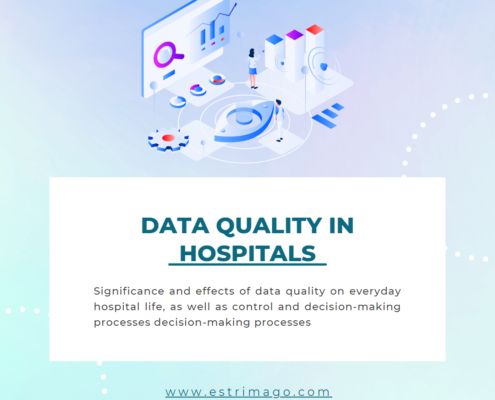 https://estrimago.com/wp-content/uploads/2023/03/Data-Quality-in-Hospital-EN.png
1080
1080
ESTRIBOSS
https://estrimago.com/wp-content/uploads/2023/03/ESTRIMAGO_web_PNG.png
ESTRIBOSS2023-03-04 18:56:412023-03-04 19:25:11Significance and impact of data quality on everyday hospital life, as well as control and decision-making processes
https://estrimago.com/wp-content/uploads/2023/03/Data-Quality-in-Hospital-EN.png
1080
1080
ESTRIBOSS
https://estrimago.com/wp-content/uploads/2023/03/ESTRIMAGO_web_PNG.png
ESTRIBOSS2023-03-04 18:56:412023-03-04 19:25:11Significance and impact of data quality on everyday hospital life, as well as control and decision-making processes https://estrimago.com/wp-content/uploads/2023/03/Episode-28-Digital-ecosystems-cyber-security-EPD-and-EPA.png
1080
1080
ESTRIBOSS
https://estrimago.com/wp-content/uploads/2023/03/ESTRIMAGO_web_PNG.png
ESTRIBOSS2023-03-04 18:41:352023-03-04 20:13:58BGM 28th programme Discussion: Digital Healtchare Ecosystems – Challenges
https://estrimago.com/wp-content/uploads/2023/03/Episode-28-Digital-ecosystems-cyber-security-EPD-and-EPA.png
1080
1080
ESTRIBOSS
https://estrimago.com/wp-content/uploads/2023/03/ESTRIMAGO_web_PNG.png
ESTRIBOSS2023-03-04 18:41:352023-03-04 20:13:58BGM 28th programme Discussion: Digital Healtchare Ecosystems – Challenges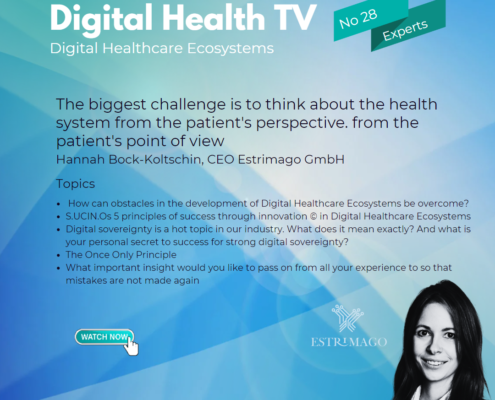 https://estrimago.com/wp-content/uploads/2023/03/28-Follow-up-Expert-The-biggest-challenge-is-to-think-about-the-health-system-from-the-patients-side.png
1080
1080
Hannah Bock-Koltschin
https://estrimago.com/wp-content/uploads/2023/03/ESTRIMAGO_web_PNG.png
Hannah Bock-Koltschin2022-07-19 11:52:442023-03-04 20:15:01BGM 28th programme Expert voice: The biggest challenge is to think about the health system from the patient’s point of view.
https://estrimago.com/wp-content/uploads/2023/03/28-Follow-up-Expert-The-biggest-challenge-is-to-think-about-the-health-system-from-the-patients-side.png
1080
1080
Hannah Bock-Koltschin
https://estrimago.com/wp-content/uploads/2023/03/ESTRIMAGO_web_PNG.png
Hannah Bock-Koltschin2022-07-19 11:52:442023-03-04 20:15:01BGM 28th programme Expert voice: The biggest challenge is to think about the health system from the patient’s point of view. https://estrimago.com/wp-content/uploads/2023/03/28-Episode-Expert-Healthcare-Wireless_-Replacing-cables-with-air.png
1080
1080
Hannah Bock-Koltschin
https://estrimago.com/wp-content/uploads/2023/03/ESTRIMAGO_web_PNG.png
Hannah Bock-Koltschin2021-12-19 11:16:342023-03-04 20:15:31BGM 28th broadcast Expert voice: Healthcare Wireless: Replacing cables with air
https://estrimago.com/wp-content/uploads/2023/03/28-Episode-Expert-Healthcare-Wireless_-Replacing-cables-with-air.png
1080
1080
Hannah Bock-Koltschin
https://estrimago.com/wp-content/uploads/2023/03/ESTRIMAGO_web_PNG.png
Hannah Bock-Koltschin2021-12-19 11:16:342023-03-04 20:15:31BGM 28th broadcast Expert voice: Healthcare Wireless: Replacing cables with air
