Digitalisation in the hospital
Interactive processes for more patient time and less costs
Summary
Summary
7Just Ebbesen, CEO of Kalnes Hospital, says: „Our hospital is leading the way in service-oriented innovation“, i.e. simplification, availability of information, a work process that gets closer and closer to the patient, the use of off-the-shelf technologies and the use of mobile staff. There is no better way to describe Lightweight ICT’s approach to real-time interactive process optimisation with high ROI.
Introduction
In an age of care worker shortages, inclusion and failure to ensure care for all, digitalisation can provide real work relief for professionals, revenue optimisation for directors and improved healthcare for patients. 8 But many in the health sector lack the investment resources. A solution is needed that delivers effective benefits for patients, staff and the treasury.
The so-called 1interactive, interdisciplinary care management in real time has just this claim: lower costs, with simultaneous quality improvement and increase in patient time in real time, taking into account human rights and detached from management in silos. It does not completely contradict the philosophy of the Lean Healthcare Management approach, but goes far beyond it. It takes into account the principle 3„every second can be vital“ and is based on the mindset that effective optimisation can only succeed if the IT tools used are an effective facilitator and aid, and the information is provided as automatically as possible and in real time, appropriate to the addressee. On the basis of the information at the „right time in the right place in the right form“, the user can make the right decision. We can see the consequences of this practice in the most modern hospitals in Europe, which are located in Scandinavia: Savings of 44 min patient time per care per shift in emergency, 250K euros through the use of queue management and many more.
Digitalisation in hospitals
Before this new type of process optimisation by means of IoT is examined in more detail, the term digitisation must be clarified in this context.
Digitisation here means the interplay of a sustainable, innovative and affordable infrastructure with automated information flows and communication channels adapted to the processes, which are made usable for the users by means of lightweight ICT and which communicate via this with the heavy ICT (cash register systems, HIS, etc.). It is not limited to the hospital itself, but can also act interdisciplinary externally via this. Digitisation is understood here not only as the use of IT and technology, but also their best possible use.
The pillars of interactive processes
1 This new way of optimising processes by means of lightweight ICT and the associated communication and information geared to the addressees is based on three pillars:
- Infrastructure
- Data quality
- Interactive and interdisciplinary process design and
- the selection of suitable tools
Infrastructure
4 Information infrastructure is understood as „a common, open (and unlimited), heterogeneous and evolving socio-technical installed base consisting of a set of IT capabilities and their users, such as operations and design“. Consequently, digitalisation can only be efficient if you build it on a solid foundation. A simple rule says: the earlier you introduce digitalisation into the planning of building projects, the higher the savings potential.
Universal cabling is replaced by universal WiFi.
This must then also meet the new requirements.
Wherever we replace cables with air, we must ensure the following points:
- Compliance with the global standard (e.g. 2.4 GhZ , max. 100 milliwatts)
- WiFi with guarantee for telephony, data and tracking
- No-sim card telephony for mobile devices
- Bring your own device philosophy
- RFID via ultrasound and Bluetooth instead of old RFID antennas or pure WiFi
Among other things, 40,000 CHF could be saved in 5 years through No Sim card telephony alone, the use of the smartphone as a working tool: pager, wayfinding and emergency alarm measuring devices, etc. Likewise, compared to conventional installations, more than a third of the costs (without discounts, local installation, no cloud IT).
Lightweight ICT and Heavy ICT
It is also no longer necessary to install a single platform for each organisation. Municipalities and countries or larger groups can also use these lightweight process tools to manage their entire clinics, homes and social wards in one data centre. The technical scalability and the prerequisites for data protection in this sensitive environment are in place. In Scandinavia, entire regions are already managed centrally.
Why did Ahus or Kalnes Hospital, for example, take this step?
5Heavy ICT (i.e. HIS, cash register systems, accounting, etc.) solutions are linked to the IT infrastructure (server, cloud, IT governance, etc.) as well as to the specialised knowledge of the IT units and developers. Only through these can continuity be guaranteed, especially in terms of security and reliability. In addition, these solutions interact with the business logic and data access layers. Lightweight ICT (platforms with widgets, apps, etc.), on the other hand, is a non-invasive solution whose interaction takes place at the presentation level.
Consequently, it can be understood as a complement to the well-known heavy ICT, because it supports the „simple, immediate needs of the user during the work process“ on the basis of less expensive technology.
6We see the advantages of such platforms in ecosystems from Google, Apple and Amazon, among others. The platform itself is stable, while the apps and widgets on the smartphones, tablets, whiteboards, etc. vary. This modular design enables flexible action in process design despite standardised software and hardware.
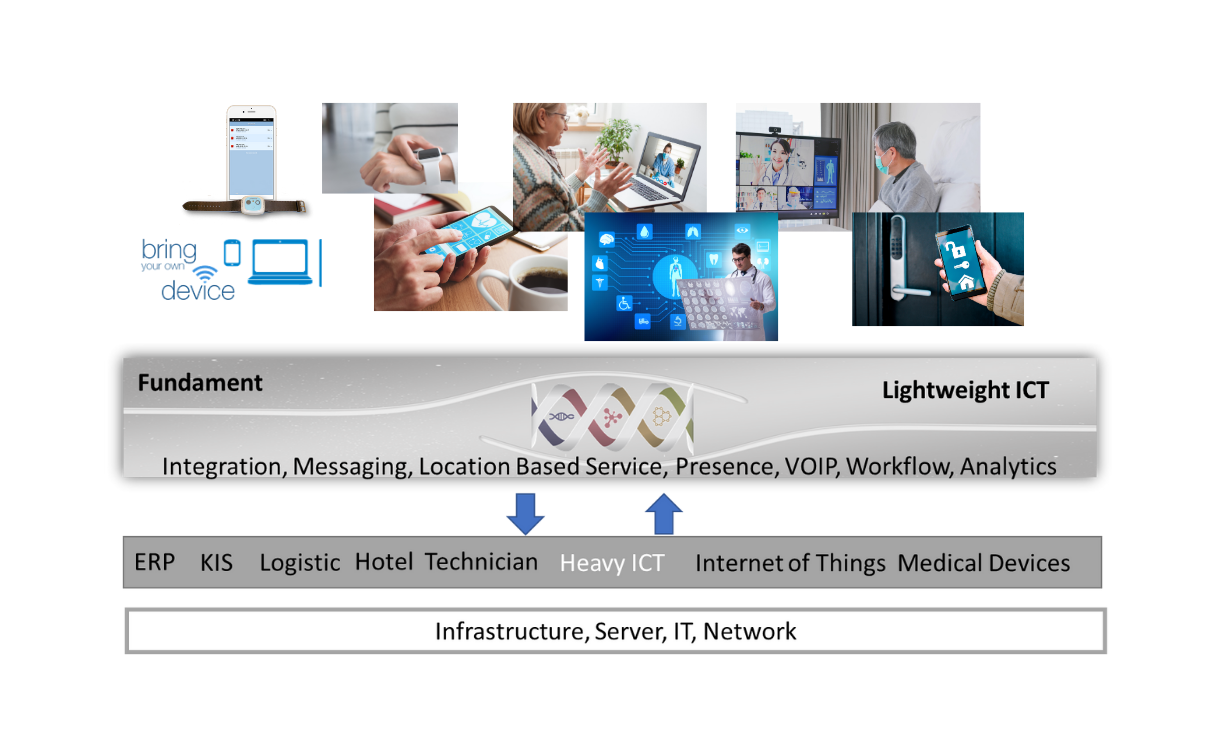
Figure 1 Simplified overview of the functionality between Heavy and Lightweight ICT and the resulting processes
Interactive and interdisciplinary process design and user orientation
8According to a 2017 study by the management consultancy Roland Berger, German hospitals were particularly criticised for „the lack of user-friendliness of clinical IT systems, inadequate performance, lack of functionality and outdated or cumbersome processes“.
This criticism clearly shows that process design and user orientation in many hospitals are not yet where they could be.
1Thanks to the use of widgets on electronic whiteboards and apps, messaging and orchestration services, visual health etc., these needs can be cushioned in a user-friendly way, and even the possibility of visual customisation can be given. Old software, e.g. on Rich Client, can also be converted to HTML 5 and thus its information made usable in better workflows. Likewise, apps of the clinics can be integrated.
It should be emphasised that the system can be used for all services: Cleaning, monitoring of technical tasks and alarms, laboratory care, etc.
The difference itself lies in the design of the views for each user level.
In Scandinavia, they work with Visi, a software for the electronic whiteboard with touch display, which serves as a substitute for flipcharts.
Mobilix is the counterpart for smartphones or tablets (Android, OS and Windows) as well as other modules.
Data quality and conclusion
Data quality will play a key role in this system as digitisation increases. Already today, data stewards and management are lacking. Millions are lost here. If one changes over to standardised lightweight ICT with data stewardship and management in a modular way, German hospitals can also profit from these systems and put their ships back on course for revenue success. New inventions are not absolutely necessary if you can „unambiguate“ the tried and tested. These were already prepared for the DACH region in 2017 in cooperation with Imatis.
Thank
Special thanks to Kalnes Hospital in Ostfold (Norway) for the reference visits, the photos and answering all questions. Anund Rannestad and Morten Andresen(www.imatis.com) or the images, as well as the numerous hours in process design, innovation and further development for the DACH region.
Literatur
[1] H. Bock: Real Time Process Management Tools – the Key to Success of the World’s Most Digitalised Hospitals, 21. 11 2017. ZHAW Lecture Series, Zürich, Zürich, Schweiz
[2] Krug, L. MAINZER MANAGER. [Online] [Zitat vom: 04. 02 2018.] http://mainzer-manager.de/lean-healthcare-management/.
[3] H. Bock.: Healthcare and workplace access for the disabled, British Humanist Association, 27 May – 14 June 2013, Item 8 General Debate, United Nations Human Rights Council, 23rd Session
[4] Hanseth, O und Lyytinen, K., Design Theory for Dynamic Complexity in Design Theory for Dynamic Complexity in Information Infrastructures: the case of building internet. 25 (1), 2010, S. 1-19
[5] Bygstad, Bendik, Generative innovation: a comparison of lightweight and heavy ICT, Journal of Information Technology, 24. 05 2016, S. 1-12
[6] Baldwin, C und Woodard. Harvard Business School. [Online] 2008, http://www.hbs.edu/faculty/Publication%20Files/09-034_149607b7-2b95-4316-b4b6-1df66dd34e83.pdf
[7] Just Ebbesen, CEO des Kalnes Hospital, Ostfold, [Online] [Zitat vom: 04. 02 2018] http://www.himss.eu/sites/himsseu/files/community/community_presentations/SeHS2017_Terje_Gaardsmoen.pdf
[8] Deutsches Ärzteblatt, H. E. Krüger-Brand, Digitalisierung im Krankenhaus: Der Infrastruktur fehlt die Finanzierung, 2017, [Online] [Zitat vom: 04. 02 2018.] https://www.aerzteblatt.de/archiv/195006/Digitalisierung-im-Krankenhaus-Der-Infrastruktur-fehlt-die-Finanzierung
Publication
Published as part of a key note speech by our CEO Hannah Bock-Koltschin at Ulmek 2018. Conference proceedings article:
6. Ulmek Symposium 2018 – Medizintechnik Aktuell, Sicheres Datenmanagement – Aufgabe für Medizintechnik und IT
You might also be interested in….
 https://estrimago.com/wp-content/uploads/2023/03/Ada-Lovelace-first-coder-1.png
1200
1200
ESTRIBOSS
https://estrimago.com/wp-content/uploads/2023/03/ESTRIMAGO_web_PNG.png
ESTRIBOSS2023-03-08 15:29:412023-03-08 15:33:16Happy Women’s day
https://estrimago.com/wp-content/uploads/2023/03/Ada-Lovelace-first-coder-1.png
1200
1200
ESTRIBOSS
https://estrimago.com/wp-content/uploads/2023/03/ESTRIMAGO_web_PNG.png
ESTRIBOSS2023-03-08 15:29:412023-03-08 15:33:16Happy Women’s day https://estrimago.com/wp-content/uploads/2023/03/Digital-Healthcare-Ecosystems_EN.png
1080
1080
ESTRIBOSS
https://estrimago.com/wp-content/uploads/2023/03/ESTRIMAGO_web_PNG.png
ESTRIBOSS2023-03-04 19:47:042023-03-04 19:58:03Digitalisation in the hospital – interactive processes for more patient time and less costs
https://estrimago.com/wp-content/uploads/2023/03/Digital-Healthcare-Ecosystems_EN.png
1080
1080
ESTRIBOSS
https://estrimago.com/wp-content/uploads/2023/03/ESTRIMAGO_web_PNG.png
ESTRIBOSS2023-03-04 19:47:042023-03-04 19:58:03Digitalisation in the hospital – interactive processes for more patient time and less costs https://estrimago.com/wp-content/uploads/2023/03/Innovationen-Healthcare-management-EN.png
1080
1080
ESTRIBOSS
https://estrimago.com/wp-content/uploads/2023/03/ESTRIMAGO_web_PNG.png
ESTRIBOSS2023-03-04 19:26:012023-03-04 19:31:23Innovations in care management: How modern hospitals save millions
https://estrimago.com/wp-content/uploads/2023/03/Innovationen-Healthcare-management-EN.png
1080
1080
ESTRIBOSS
https://estrimago.com/wp-content/uploads/2023/03/ESTRIMAGO_web_PNG.png
ESTRIBOSS2023-03-04 19:26:012023-03-04 19:31:23Innovations in care management: How modern hospitals save millions https://estrimago.com/wp-content/uploads/2023/03/Data-Quality-in-Hospital-EN.png
1080
1080
ESTRIBOSS
https://estrimago.com/wp-content/uploads/2023/03/ESTRIMAGO_web_PNG.png
ESTRIBOSS2023-03-04 18:56:412023-03-04 19:25:11Significance and impact of data quality on everyday hospital life, as well as control and decision-making processes
https://estrimago.com/wp-content/uploads/2023/03/Data-Quality-in-Hospital-EN.png
1080
1080
ESTRIBOSS
https://estrimago.com/wp-content/uploads/2023/03/ESTRIMAGO_web_PNG.png
ESTRIBOSS2023-03-04 18:56:412023-03-04 19:25:11Significance and impact of data quality on everyday hospital life, as well as control and decision-making processes
