Innovations in care management: How modern hospitals save millions
Summary
The secret of modern clinics lies in having the „right information, at the right time, in the right place and in the right form“, because this allows them to target resources more effectively, save idle time and directly or indirectly increase time with the patient.
Introduction
If one looks at the Hospital Rating Report of the last few years, there has been a significant increase in hospitals at risk of over-indebtedness. At the same time, according to the Association of Hospitals, there is a shortage of billions in investment funds to compensate for the lack of infrastructure and to invest in the age of digitalisation. It remains questionable how a reliable quality of care can be achieved at these locations, also for future generations. So far, the potential savings have been in the areas of investment backlogs, staff savings and outsourcing and purchasing of low-quality materials. But as we have seen recently, a shortage of good skilled labour, well-maintained capital equipment and healthy outsourcing is exacerbating the threatening situation.
So what specifically can you do to become profitable again?

Picutre [1]We believe in the expertise of you and your staff.
We enable you to have the right basis for decision-making at all times.
That’s the secret behind real-time process optimisation: we make full use of your potential – it’s that simple.
Revenue optimisation and data quality
Before you can enter the age of digitalisation, you need money to address your infrastructure deficiencies. Fortunately, technological progress brings us not only cheap and good alternatives in terms of infrastructure, but also in terms of data.
Before you save at the wrong end – staff and infrastructure – clean up your data. As banal as this sounds, it is effective.
As an example, I would like to mention a Swiss clinic with a drug turnover of 80 million CHF. For years, the content of the systems had not been maintained. The interfaces were therefore error-prone. The abolition of several clients for the logistics locations, the abolition of paper recording and the individual recording of medicines instead of article groups alone, in combination with Data Excellence and Dataquality systems as well as a holistic parameterisation of the information flow from input to invoicing, brought savings in this area of 15 million CHF. In addition, better purchase prices were achieved with the new data management.
As another example, I would like to mention the use of the same data quality tool for the area of medical controlling and billing. It was possible to increase the level of emergency billing by 15%. When comparing the medically recorded services with those of the written reports, it was found that the service recording did not correlate with the severity of the injury. This was due to the fact that the entries in the emergency could not be made per DRG or CHOP package. For more severe cases, significantly more clicks had to be made. This meant that residents in particular did not make all the entries in the hectic day-to-day emergency. At the same time, we noticed that the health insurance companies did not accept many entries because the clinical picture did not match the entry. So we stored medical rules for better coding and better billing, which were automatically sent to the parties involved every day. At the same time, together with the emergency staff, we optimised the entry by enabling it in convenient packages. Cancellation rates went down and so did the resources needed, coding improved and more could be billed. This plus enabled us to invest further in building real-time information flows appropriate to the addressees.
Process design and construction of an addressee-oriented management book in real time
You may know management books from your controlling. But here we mean those that serve to give us the right information at the right place at any time. Their visualisation results from the process design based on Lightweight ICT.
The first level of information flows could be, for example, the patient overview on the ward, which can be operated on a widget in a whiteboard. If the patient is discharged around 2 pm, the doctor marks this on the patient overview. At the same time, this information is sent to the cleaning service. Here, however, not with the patient’s name, but with the time of the free room for cleaning. Since the room has a locating function, the beds are automatically adjusted on the bed disposition. There is no need to phone back and forth.
Through this technology, the Kalnes Hospital in Ostfold, Norway, for example, was able to make an analysis of the deployment needs of its cleaning staff and deploy them in a more targeted manner. This indirectly saved staff because no additional staff was needed.
Importance of facility management in the age of digitalisation
Digitalisation places new demands on a clinic. There is no doubt that the IT department plays an important role, but what would it be without facility management?
When we enter the world of real-time process optimisation and addressee-oriented information flows in order to ensure a naturally liveable, interactive and interdisciplinary care management, we must not forget the 85% percent of the iceberg that lies beneath the water surface.
Mobility means battery dependency followed by the urge to get along without SIM cards and E-SMOG.
and E-SMOG. Therefore, the most important thing for the start of digitalisation is to move away from universal cabling to universal wifi. However, this requires that the Wifi is designed for voice, data and positioning. Furthermore, devices must be used that are role-based and not dependent on the respective device. Only in this way can battery independence be maintained as far as possible.
Modern tracking systems such as ultrasound or Bluetooth must also be used.
In other words, facility management, with its decisions, lays the virtual foundation for automated revenue optimisation in real time.
In addition, it is a major user of this new technology and helps to gain valuable patient time, bridge idle times and always have the right information at the right place at the right time.
Conclusion
Hospitals can save millions by reducing costs while improving quality and increasing patient time in real time, taking into account human rights and detaching themselves from siloed management, or in short: by integrating interactive, interdisciplinary care management into their daily routine.
It does not necessarily have to be expensive large-scale acquisitions. Even on a small scale, idle times can be saved and thus drive the mills of revenue optimisation. However, when using iOT tools, it is important to make sure that facility management already acts together with IT in the planning phase and that sensible savings approaches are already created here.
Publication / Key Note Speech
Our CEO Hannah Bock-Koltschin was represented there as a key note speaker.
According to her presentations at Wümek 2018, renowned institutes, including Frauenhofer, considered optimisation beyond silo thinking to be „not yet possible“. At the time, she was the first to implement a solution for optimisation both vertically (silos) and horizontally.
2017/2018 thanks to the most innovative technology from Korea and Scandinavia – cleverly combined in a retirement home in the Swiss mountains.
This presentation triggered a wave of Ahas.
You want to know more about how to really optimise? Then ask us.we believe in you and your staff
You may be interested in…..
 https://estrimago.com/wp-content/uploads/2023/03/Ada-Lovelace-first-coder-1.png
1200
1200
ESTRIBOSS
https://estrimago.com/wp-content/uploads/2023/03/ESTRIMAGO_web_PNG.png
ESTRIBOSS2023-03-08 15:29:412023-03-08 15:33:16Happy Women’s day
https://estrimago.com/wp-content/uploads/2023/03/Ada-Lovelace-first-coder-1.png
1200
1200
ESTRIBOSS
https://estrimago.com/wp-content/uploads/2023/03/ESTRIMAGO_web_PNG.png
ESTRIBOSS2023-03-08 15:29:412023-03-08 15:33:16Happy Women’s day https://estrimago.com/wp-content/uploads/2023/03/Digital-Healthcare-Ecosystems_EN.png
1080
1080
ESTRIBOSS
https://estrimago.com/wp-content/uploads/2023/03/ESTRIMAGO_web_PNG.png
ESTRIBOSS2023-03-04 19:47:042023-03-04 19:58:03Digitalisation in the hospital – interactive processes for more patient time and less costs
https://estrimago.com/wp-content/uploads/2023/03/Digital-Healthcare-Ecosystems_EN.png
1080
1080
ESTRIBOSS
https://estrimago.com/wp-content/uploads/2023/03/ESTRIMAGO_web_PNG.png
ESTRIBOSS2023-03-04 19:47:042023-03-04 19:58:03Digitalisation in the hospital – interactive processes for more patient time and less costs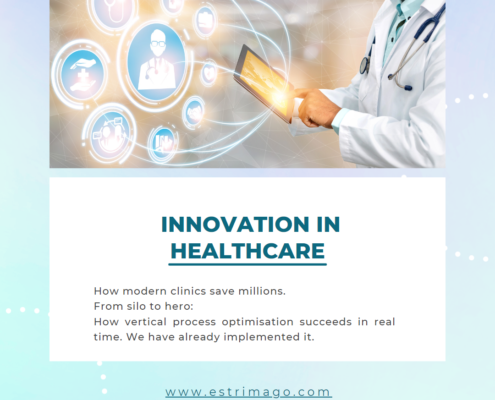 https://estrimago.com/wp-content/uploads/2023/03/Innovationen-Healthcare-management-EN.png
1080
1080
ESTRIBOSS
https://estrimago.com/wp-content/uploads/2023/03/ESTRIMAGO_web_PNG.png
ESTRIBOSS2023-03-04 19:26:012023-03-04 19:31:23Innovations in care management: How modern hospitals save millions
https://estrimago.com/wp-content/uploads/2023/03/Innovationen-Healthcare-management-EN.png
1080
1080
ESTRIBOSS
https://estrimago.com/wp-content/uploads/2023/03/ESTRIMAGO_web_PNG.png
ESTRIBOSS2023-03-04 19:26:012023-03-04 19:31:23Innovations in care management: How modern hospitals save millions https://estrimago.com/wp-content/uploads/2023/03/Data-Quality-in-Hospital-EN.png
1080
1080
ESTRIBOSS
https://estrimago.com/wp-content/uploads/2023/03/ESTRIMAGO_web_PNG.png
ESTRIBOSS2023-03-04 18:56:412023-03-04 19:25:11Significance and impact of data quality on everyday hospital life, as well as control and decision-making processes
https://estrimago.com/wp-content/uploads/2023/03/Data-Quality-in-Hospital-EN.png
1080
1080
ESTRIBOSS
https://estrimago.com/wp-content/uploads/2023/03/ESTRIMAGO_web_PNG.png
ESTRIBOSS2023-03-04 18:56:412023-03-04 19:25:11Significance and impact of data quality on everyday hospital life, as well as control and decision-making processes https://estrimago.com/wp-content/uploads/2023/03/Episode-28-Digital-ecosystems-cyber-security-EPD-and-EPA.png
1080
1080
ESTRIBOSS
https://estrimago.com/wp-content/uploads/2023/03/ESTRIMAGO_web_PNG.png
ESTRIBOSS2023-03-04 18:41:352023-03-04 20:13:58BGM 28th programme Discussion: Digital Healtchare Ecosystems – Challenges
https://estrimago.com/wp-content/uploads/2023/03/Episode-28-Digital-ecosystems-cyber-security-EPD-and-EPA.png
1080
1080
ESTRIBOSS
https://estrimago.com/wp-content/uploads/2023/03/ESTRIMAGO_web_PNG.png
ESTRIBOSS2023-03-04 18:41:352023-03-04 20:13:58BGM 28th programme Discussion: Digital Healtchare Ecosystems – Challenges https://estrimago.com/wp-content/uploads/2023/03/28-Follow-up-Expert-The-biggest-challenge-is-to-think-about-the-health-system-from-the-patients-side.png
1080
1080
Hannah Bock-Koltschin
https://estrimago.com/wp-content/uploads/2023/03/ESTRIMAGO_web_PNG.png
Hannah Bock-Koltschin2022-07-19 11:52:442023-03-04 20:15:01BGM 28th programme Expert voice: The biggest challenge is to think about the health system from the patient’s point of view.
https://estrimago.com/wp-content/uploads/2023/03/28-Follow-up-Expert-The-biggest-challenge-is-to-think-about-the-health-system-from-the-patients-side.png
1080
1080
Hannah Bock-Koltschin
https://estrimago.com/wp-content/uploads/2023/03/ESTRIMAGO_web_PNG.png
Hannah Bock-Koltschin2022-07-19 11:52:442023-03-04 20:15:01BGM 28th programme Expert voice: The biggest challenge is to think about the health system from the patient’s point of view. https://estrimago.com/wp-content/uploads/2023/03/28-Episode-Expert-Healthcare-Wireless_-Replacing-cables-with-air.png
1080
1080
Hannah Bock-Koltschin
https://estrimago.com/wp-content/uploads/2023/03/ESTRIMAGO_web_PNG.png
Hannah Bock-Koltschin2021-12-19 11:16:342023-03-04 20:15:31BGM 28th broadcast Expert voice: Healthcare Wireless: Replacing cables with air
https://estrimago.com/wp-content/uploads/2023/03/28-Episode-Expert-Healthcare-Wireless_-Replacing-cables-with-air.png
1080
1080
Hannah Bock-Koltschin
https://estrimago.com/wp-content/uploads/2023/03/ESTRIMAGO_web_PNG.png
Hannah Bock-Koltschin2021-12-19 11:16:342023-03-04 20:15:31BGM 28th broadcast Expert voice: Healthcare Wireless: Replacing cables with air
